
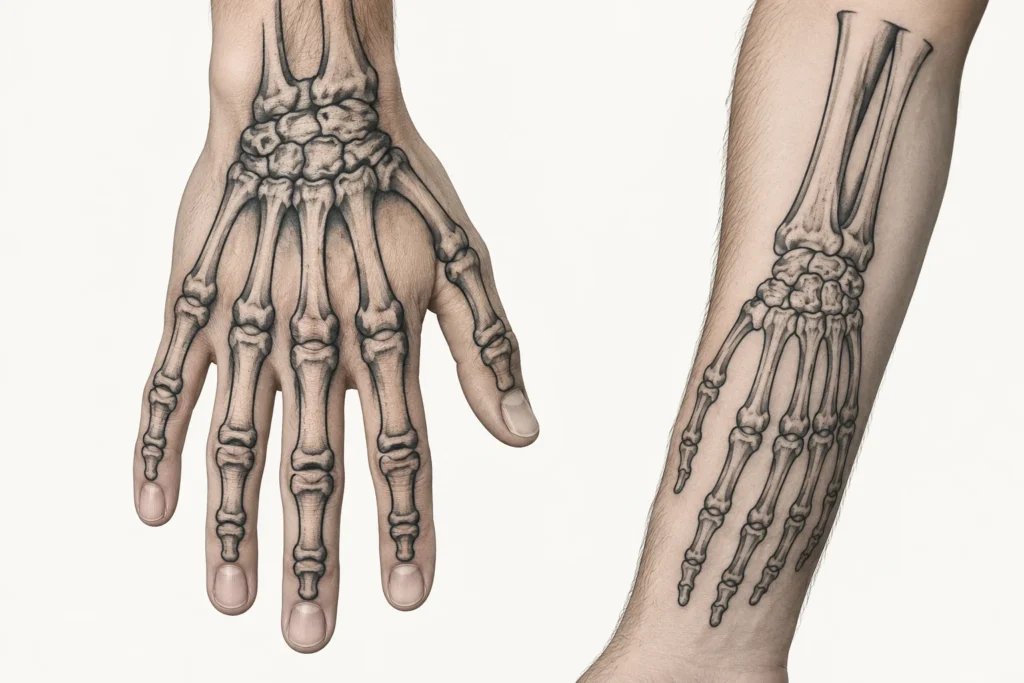
Skeleton hand tattoo meaning depends on the wearer. The bones can represent mortality, remembrance, or a personal response to death; the design can also be chosen simply for its appearance. There’s no single interpretation that applies to every skeleton hand tattoo. Its details and the wearer’s own explanation give it context.
Understanding those possibilities helps you choose a design or understand someone else’s without treating the image as a code with one fixed answer.
Skeleton hand tattoo meaning: the central idea
A skeleton hand tattoo depicts the bones of a hand. As a symbol, it can serve as a reminder that life ends. For someone who chooses that interpretation, the exposed bones make mortality visible in an otherwise familiar part of the body.
That reminder doesn’t have to express despair. A wearer might use it to mean “make time for what matters” or “appreciate being alive.” The same image can hold both an awareness of death and an appreciation of everyday life.
The phrase memento mori, meaning “remember that you must die,” describes this kind of reminder. It’s a possible framework for understanding the design, but it shouldn’t automatically become its label. A person may choose skeletal imagery without intending a connection to that phrase or its traditions.
The useful distinction is between an interpretation the image allows and a meaning the wearer actually intended. Bones can suggest mortality; they can’t tell you how someone feels about it.
Remembrance, survival, and personal significance
A wearer can give a skeleton hand tattoo a memorial meaning through a personal connection. For example, someone might add a loved one’s initials or a significant date to make the design a tribute. In that hypothetical design, the identifying detail connects the bones to a particular person or memory.
Even then, the story may remain private. A date could mark a birth, a death, or another event. Its presence alone doesn’t explain which.
Someone could also choose the tattoo after surviving a difficult experience, using it to express endurance or a changed relationship with fear. Another person might intend it as an acknowledgment of loss or uncertainty. These are possible personal meanings, rather than facts that can be read from every skeletal design.
Avoid assuming that a wearer has experienced bereavement, trauma, or illness. Those connections require the person’s own account. If you’re planning a tattoo around such an experience, decide which part of the story you want visible and which part you prefer to keep to yourself.
When the appeal is the design itself
A skeleton hand tattoo doesn’t need a deeper symbolic explanation. An interest in anatomy, horror illustration, or the visual effect of bones can be enough reason to choose it.
Style can change the mood without establishing a fixed meaning. A simplified skeletal hand with rounded shapes might feel playful. Fine outlines that describe individual joints can emphasize anatomical detail. Heavy shadows and exaggerated bones can create a more ominous effect.
Those differences describe how the drawing looks. They don’t establish the wearer’s beliefs, personality, or affiliations. A dark treatment may reflect a taste in artwork, while a delicate treatment could still carry a deeply personal association with death.
If appearance is your main reason for choosing the tattoo, explain what attracts you to it. “I like the way the bones follow the fingers” gives an artist a clearer starting point than attaching a symbolic explanation you don’t actually share.
Bone overlays, skeletal hands, and added symbols
The phrase “skeleton hand tattoo” can describe two different arrangements. A bone overlay follows the wearer’s own hand, placing drawn bones across the back of the hand and fingers. A separate illustration depicts a skeletal hand as a complete subject and can sit elsewhere, such as on a forearm.
One follows the wearer’s hand; the other depicts a hand as a separate image.
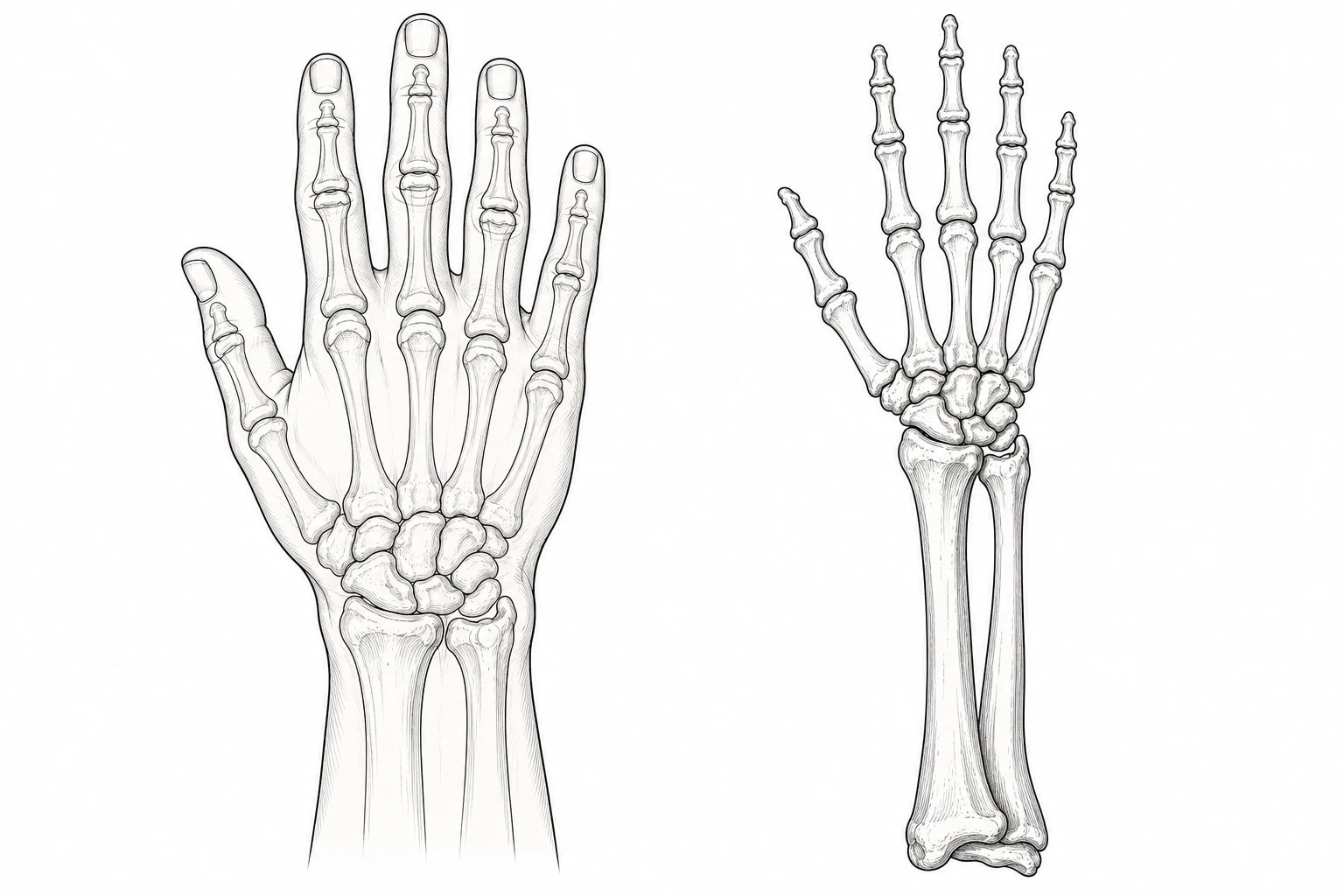
This distinction separates placement from motif. Placement is where the tattoo sits. The motif is what it depicts. A skeletal hand on a forearm still has a hand motif, while a skull tattoo on the hand has a skull motif. They share skeletal imagery, but they depict different subjects.
Added elements can give the wearer more ways to express an intention:
- A rose: A skeletal hand holding a rose could express someone’s chosen contrast between life and death, or connect with a personal memory. The flower alone doesn’t establish that story.
- A reaching gesture: A skeletal hand reaching toward another hand could suggest connection, separation, or longing, depending on the composition and the wearer’s intention.
- Initials or a date: These can anchor the image to a person or event, although their significance may only be clear to the wearer.
These are possible readings, not a universal symbolism checklist. An added detail may also be there because it suits the composition. You don’t need to assign a separate meaning to every line or object.
Choose the meaning you want to communicate
Start by putting your intention into one sentence. It might be “I want a reminder to value my time,” “I want to remember someone,” or “I like anatomical drawings.” That sentence can guide the design without needing to appear in the tattoo.
Next, choose the details that support it. For a memorial, one meaningful initial may say more to you than several unrelated symbols. For an anatomical design, the relationship between the drawn bones and the hand may be the main feature.
Discuss both the intention and the appearance with your artist. Explain what the design means to you, which details matter, and whether you want the result to feel solemn, playful, or focused on anatomy. Bring visual references that help communicate those preferences. The skeleton hand tattoo ideas page can help you compare possible treatments.
Viewers may still interpret the result differently. A skeleton hand tattoo can carry a personal story, a reminder of mortality, or a purely visual appeal. The wearer’s intention and the specific design provide a better understanding than a fixed list of meanings.
For more detail, see skeleton hand tattoo drawing.
For more detail, see hand tattoos.

