
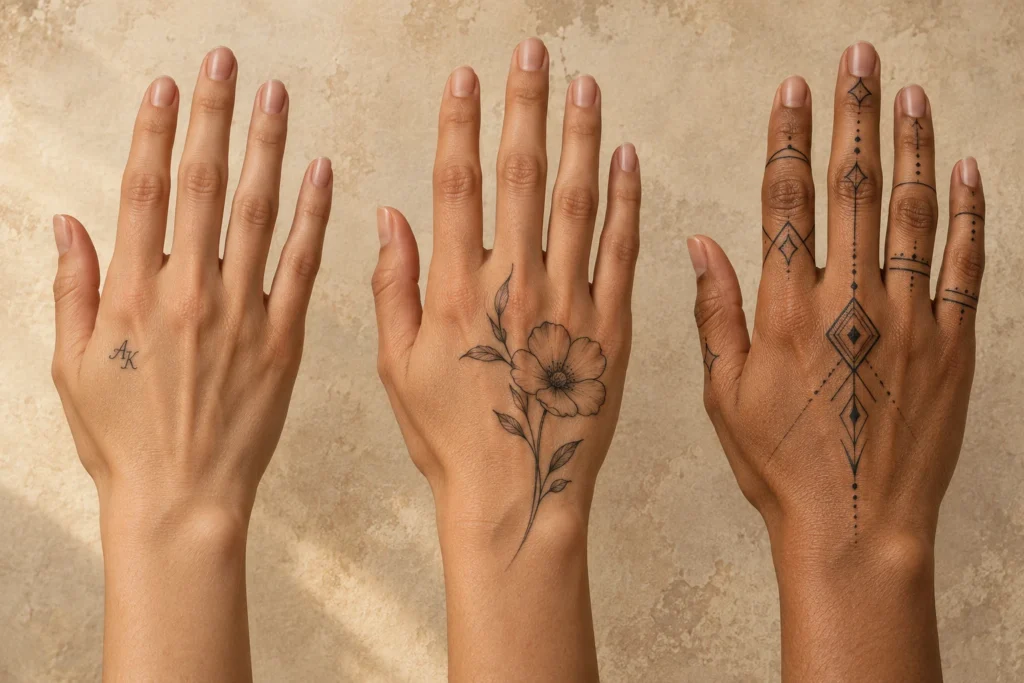
Hand tattoo meaning depends on the design, the wearer’s intention and any relevant cultural context. Placement on the hand doesn’t give every tattoo one shared meaning. A name might commemorate someone, while a decorative pattern might simply reflect the wearer’s taste. Neither can be interpreted reliably from placement alone.
To understand a particular tattoo, separate what you can see from what you know about it. The image, its arrangement and its location are visible; the reason someone chose it may remain private.
What determines hand tattoo meaning?
A hand tattoo’s meaning is what its wearer intends it to express, together with any relevant symbolic or cultural associations. Those elements can overlap, but they aren’t interchangeable. Three distinctions help:
- Personal intention: The memory, idea or preference behind the wearer’s choice.
- Documented association: A meaning supported within a particular tradition, community or historical setting.
- Observer interpretation: What someone looking at the tattoo thinks it represents.
An observer’s interpretation may differ from the wearer’s intention. Recognizing a motif doesn’t establish why someone chose it, and a meaning found in a design guide may not apply to their tattoo.
A tattoo can also carry several meanings. Someone might choose a design because it recalls a person and because they like its shape. Equally, they may choose it entirely for its appearance. A decorative reason is a complete explanation; there doesn’t need to be a hidden message.
How different designs can express different meanings
Specific examples show why the design alone rarely supplies the whole answer. The situations below are hypothetical, rather than fixed definitions of these motifs.
Initials or a date: Someone could choose a relative’s initials as a remembrance. Another person could use their own initials, or select a date marking a personal milestone. Even when the lettering is readable, its significance may not be apparent. A date alone doesn’t tell you whether it records a birth, a loss or another event.
A flower: One wearer might choose a flower that grew in a family garden. Another might select the same flower because its outline suits the space on their hand. Neither choice requires a traditional symbolic meaning. If a particular cultural association matters to the design, that association needs its own context and evidence.
An abstract pattern: A pattern could be chosen for its rhythm, symmetry or fit around the knuckles. It might also be a personal drawing. Without further information, describing its visible shapes is more reliable than assigning it an emotional meaning.
Skeleton imagery: A wearer could choose a skeleton hand tattoo as a personal reflection on mortality, an interest in anatomy or a preference for the visual style. These are possible intentions, not conclusions that follow from seeing bones tattooed on a hand.
The useful question is what this particular design means to this particular person. A general list of symbol meanings can’t answer that on its own.
Does placement on the hand change the meaning?
Placement can contribute to someone’s intention, but it doesn’t create a universal symbolic code. It helps to distinguish where a tattoo sits, how it is displayed and what it represents.
On the back of the hand, a design can form a composition across the area between the wrist and knuckles. A wearer might choose that position because they want to see the artwork often or because the shape fits there. The position alone doesn’t establish confidence, rebellion or any other personality trait.
Separate letters or small motifs can form a sequence across several fingers. Their arrangement may help communicate a word or connect related elements. A small finger tattoo, however, doesn’t automatically have a different meaning from the same motif elsewhere.
A palm design is presented differently as the hand opens and turns. That can matter to the wearer’s concept, but it doesn’t establish secrecy, spirituality or a prescribed meaning.
Be equally cautious with claims about left-hand and right-hand symbolism. If a distinction comes from a particular belief or tradition, it needs to be explained within that setting. Without that context, choosing one hand over the other tells you little about the intended message.
When cultural or religious context matters
A personal explanation and a historical explanation answer different questions. Someone can explain why they chose a design without establishing where it originated or how a community understands it.
Before describing a motif as culturally or religiously significant, identify the exact design and the specific tradition being discussed. Broad labels such as “spiritual symbol” leave too much unresolved. The relevant details may include the wording of an inscription, the arrangement of elements and the circumstances in which the design is used.
Permanent tattoos and temporary henna decoration also need to be distinguished. They are different practices; visual similarities don’t make their uses or meanings interchangeable. Neither should be treated as a single tradition with one shared interpretation.
If a design draws on a living cultural or religious practice, seek information grounded in that community before adopting or explaining it. A generic symbol chart isn’t enough to establish its significance or appropriate use.
Appearance alone is also insufficient to identify someone’s faith, heritage or group affiliation. An unfamiliar tattoo is a reason to acknowledge missing context, rather than fill the gap with a confident label.
How to choose a design that reflects your intention
Start with a plain sentence about what you want: “I want to remember my grandfather,” “I want a reminder of a personal change,” or “I like this pattern.” That gives you a clearer starting point than choosing a symbol and searching afterward for a meaning that fits.
Then work through four decisions:
- Define your intention. Decide whether the tattoo should express a specific idea, remain private or serve a decorative purpose.
- Identify the exact motif. Specify the lettering, shapes and arrangement instead of relying on a broad label.
- Check claimed associations. Verify cultural, religious or historical explanations that influence your choice. Keep uncertain claims separate from your personal interpretation.
- Explain the concept to your artist. Bring the intended meaning alongside visual references, and discuss how placement and composition support it.
You don’t have to make a personal meaning obvious to everyone. If you’re interpreting someone else’s tattoo, ask respectfully when appropriate and accept that they may prefer to keep the explanation private.
Hand tattoo meaning comes from the design and its context, with the wearer’s explanation helping you understand their intention when available. For broader design and placement exploration, continue to the guide to hand tattoos.

