
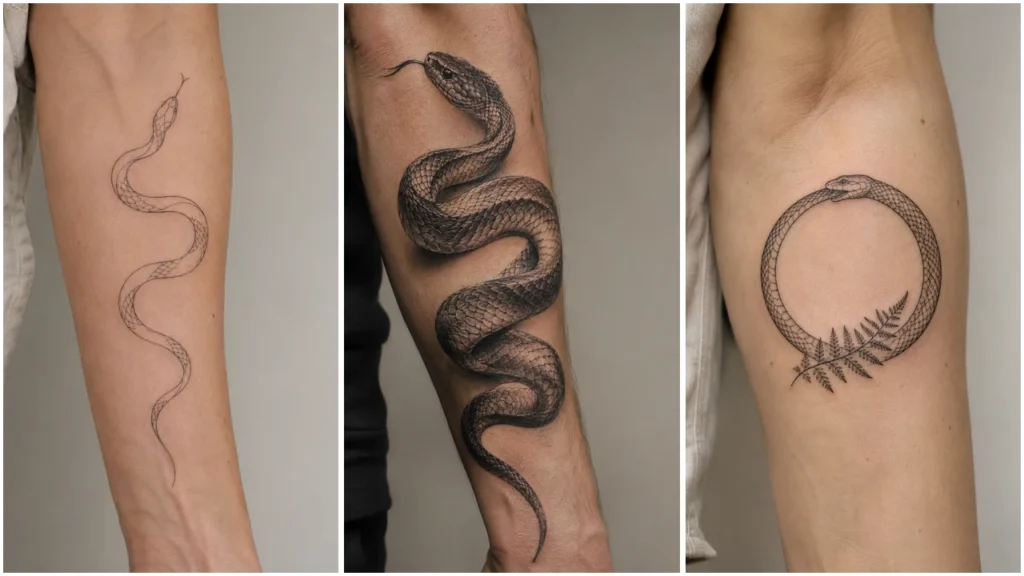
Snake forearm tattoos can stretch along your arm, sit in a compact coil, or wrap around it. These 20 design concepts explore different styles, placements, and pairings to help you choose a direction. Treat them as starting points for an artist discussion, with size and orientation tailored to your arm.
Minimal and Open Designs
These five concepts use restrained lines and open skin to give the snake a clear shape.
1. Fine Line S-Curve Snake
A slender snake follows the inner forearm in two gentle bends.
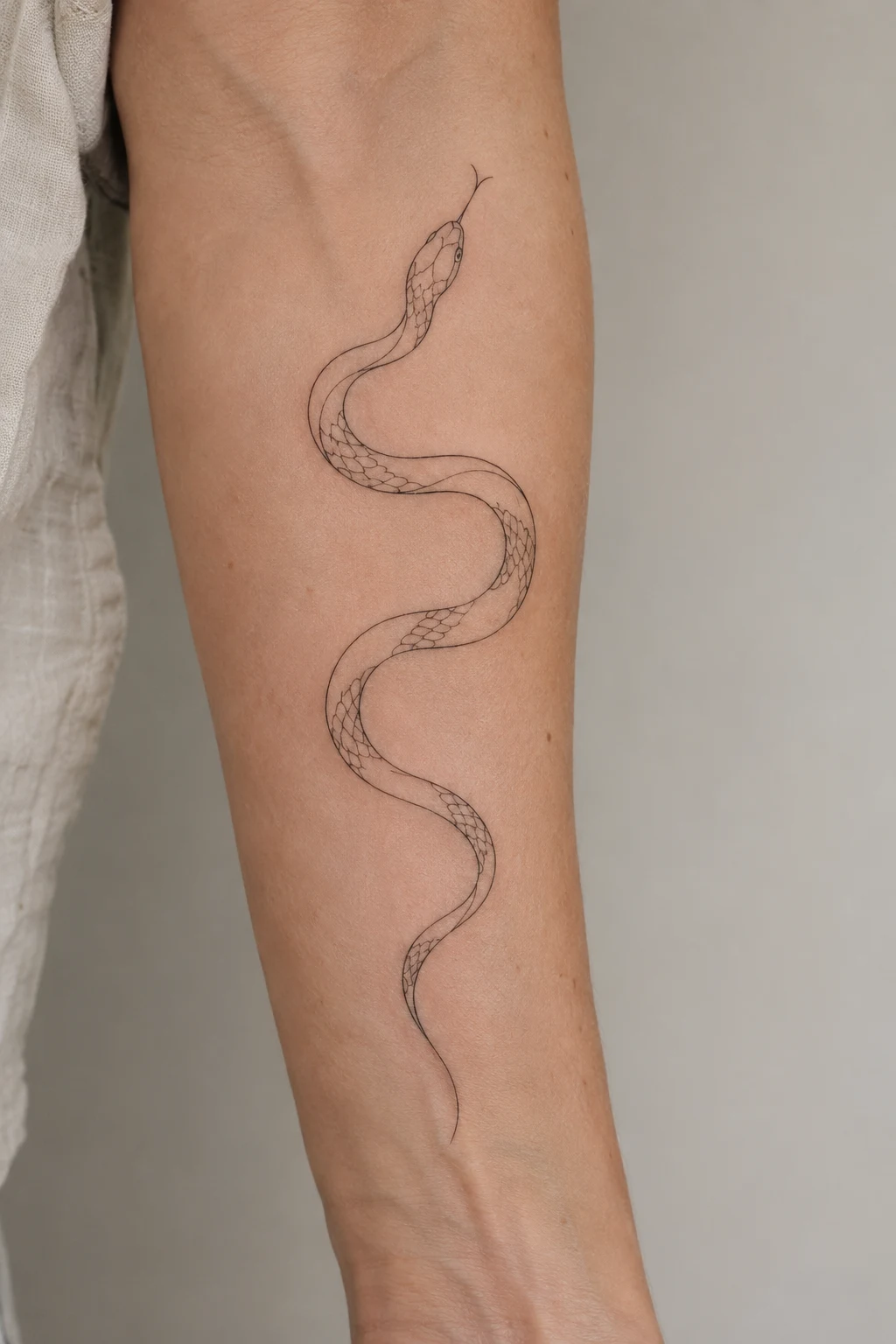
Choose this for an elongated, understated design. Decide how far it should extend between wrist and elbow, then ask your artist how much scale detail fits that size.
2. Small Coiled Snake
A loose coil keeps the design contained just above the wrist.
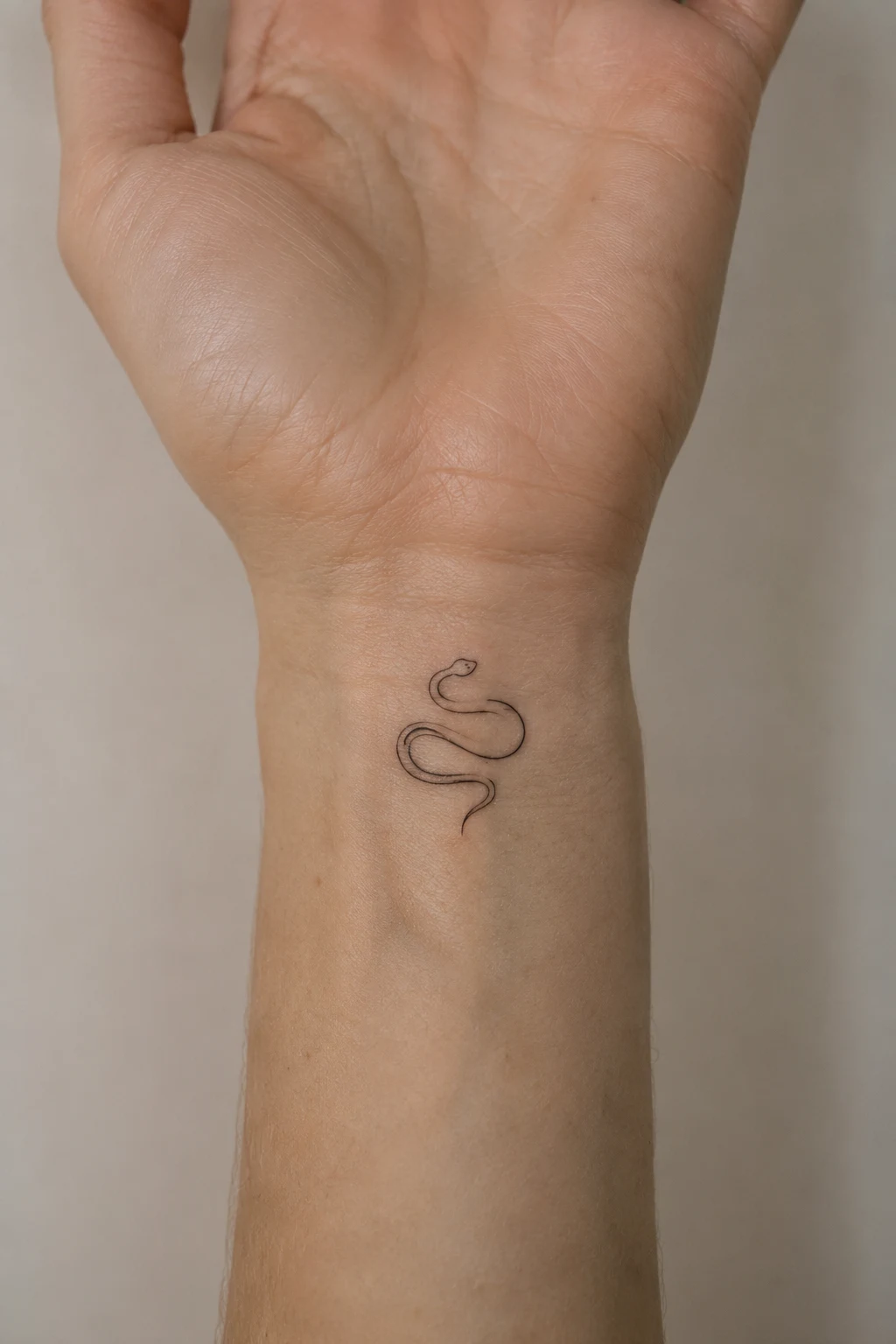
The compact motif leaves space for other tattoos nearby. Keep the head and tapered tail visibly separate so the coil reads clearly.
3. Snake With a Dashed Movement Trail
A curved trail gives a small snake a playful sense of movement.
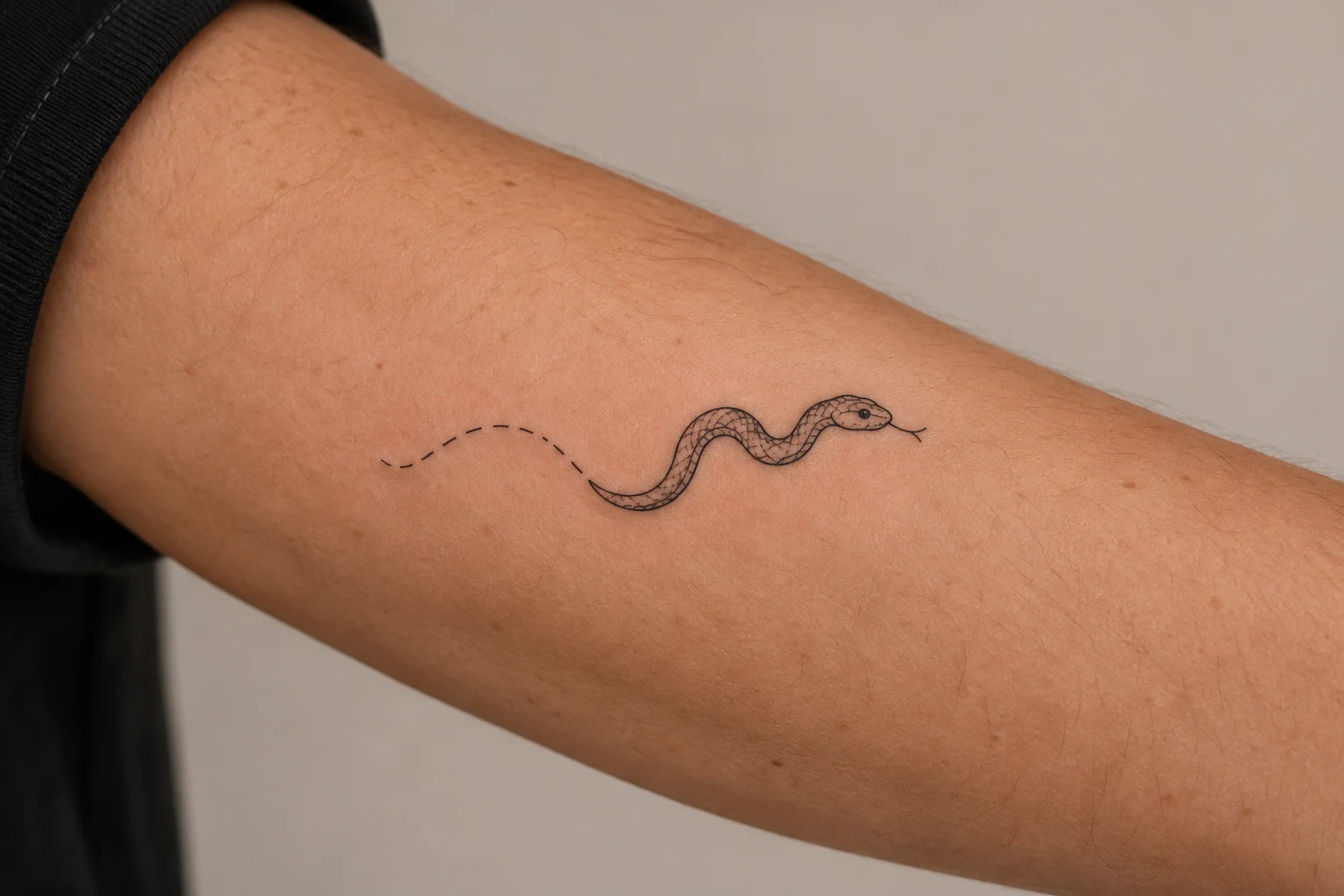
The dashes extend the composition without introducing another large subject. Choose this if you prefer a lighthearted drawing with a simple face over detailed animal anatomy.
4. Angular Geometric Snake
Sharp bends and faceted segments create a structured, lengthwise design.
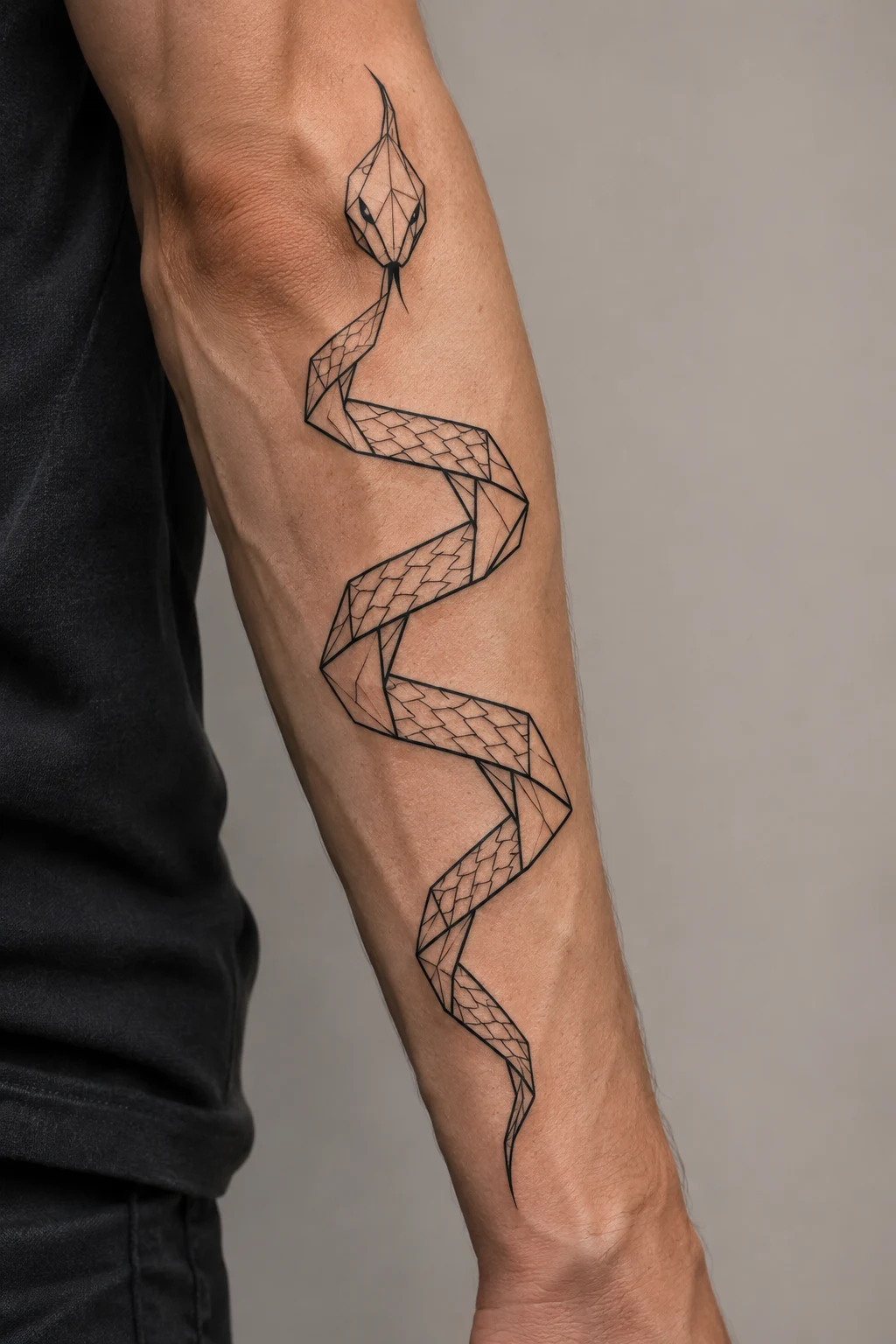
If flowing curves feel too soft for your taste, consider an angular design. Leave space between adjacent segments so the body remains easy to follow.
5. Snake Beneath a Crescent Moon
A small crescent sits above a narrow, loosely curled snake.
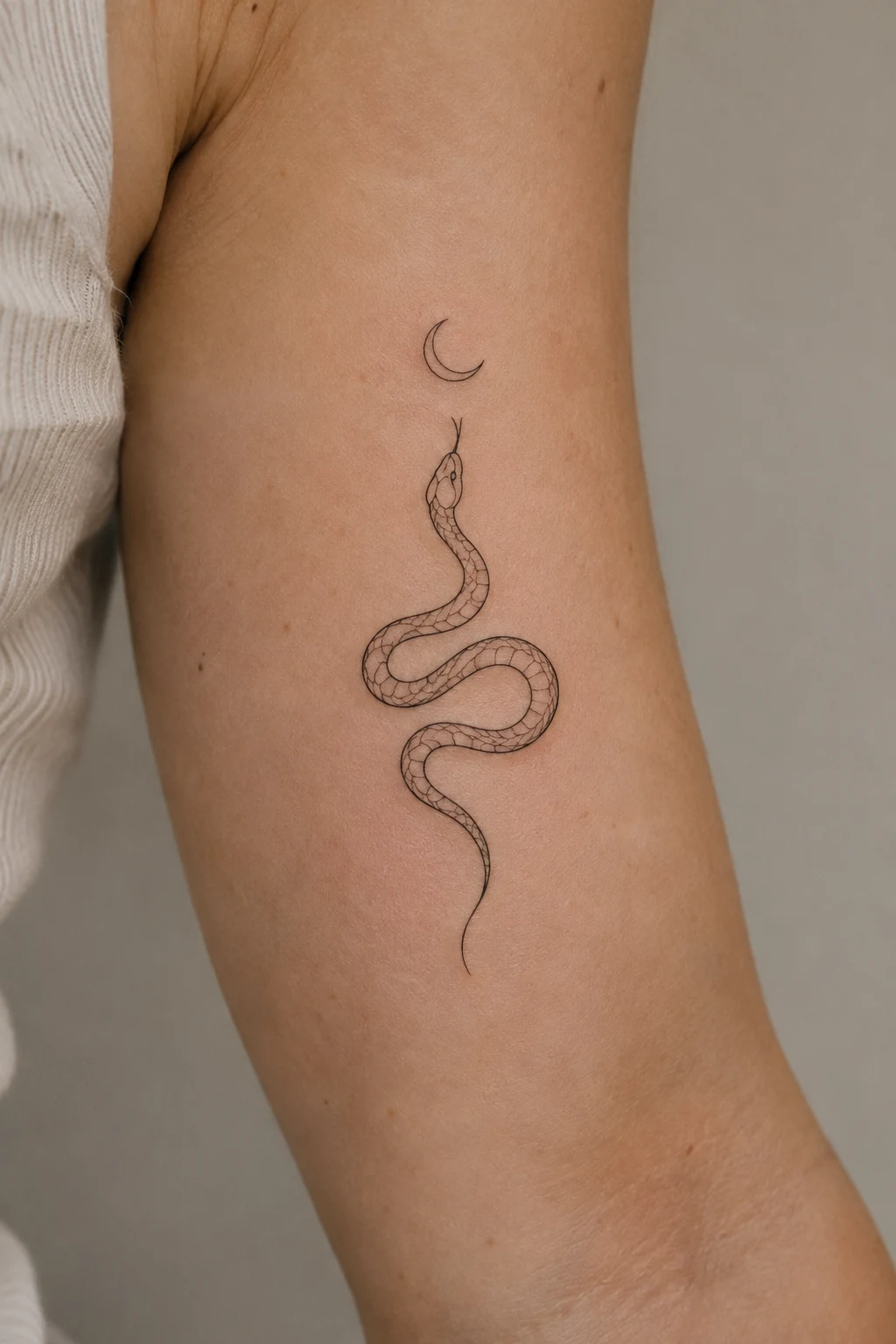
Keep the moon small for a subtle accent, or enlarge it for a more balanced pairing. Any personal meaning can come from you; the composition needs no fixed spiritual interpretation.
Bold and Graphic Snake Forearm Tattoos
Strong outlines, solid shapes, and patterned bodies give these designs more visual weight.
6. Solid Black Snake Silhouette
Broad black curves make the snake’s outline the main feature.

Without scales or shading, the silhouette puts the focus on shape. Open gaps between the bends help distinguish the body’s path, especially where it doubles back.
7. Traditional Snake With Red Accents
Bold outlines frame a raised head and restrained red belly accents.
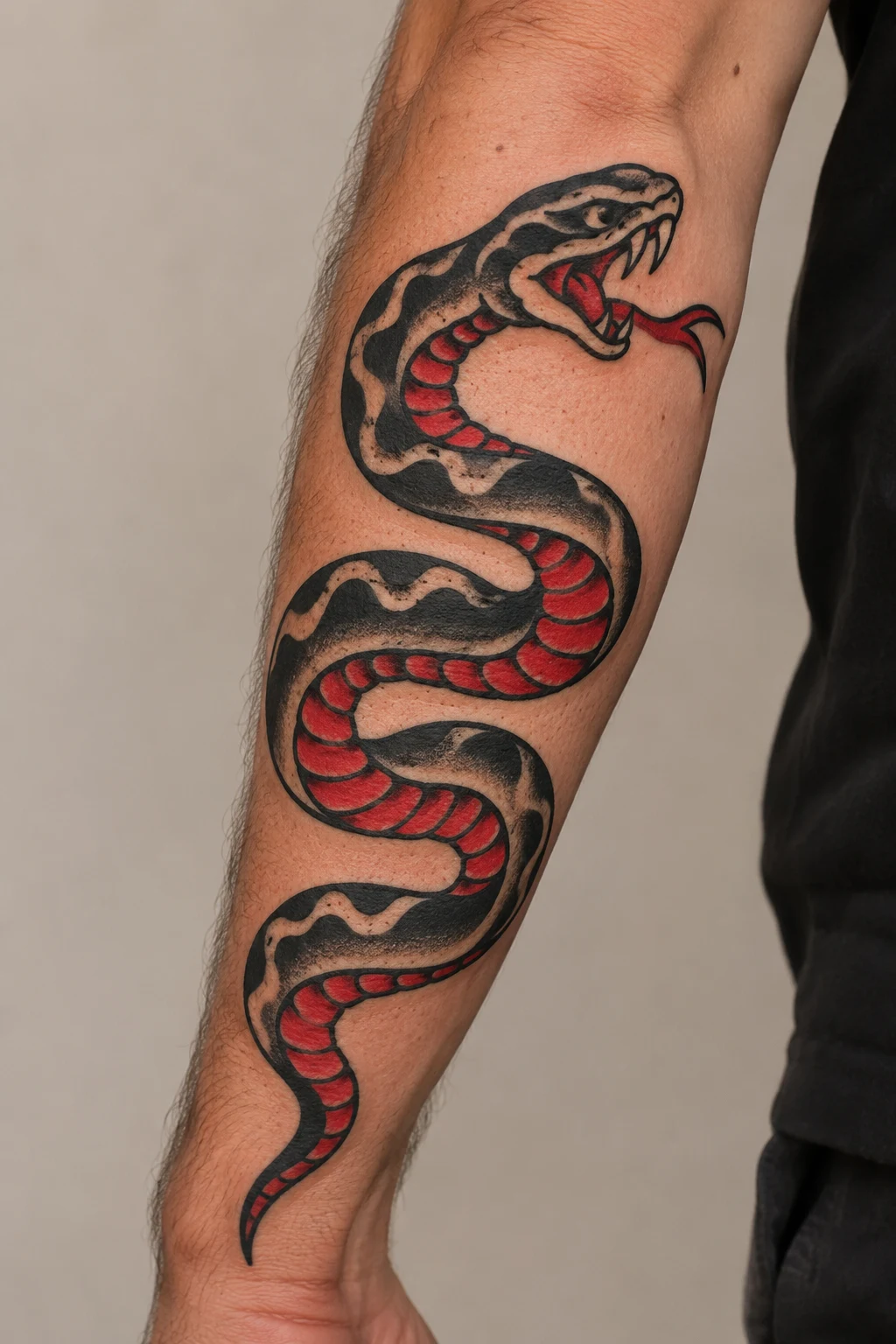
This suits readers drawn to illustrative color and a compact composition. Concentrating red along the underside gives the color a clear role without competing with every scale.
8. Negative-Space Snake in a Black Panel
An uninked snake winds through an elongated field of black.
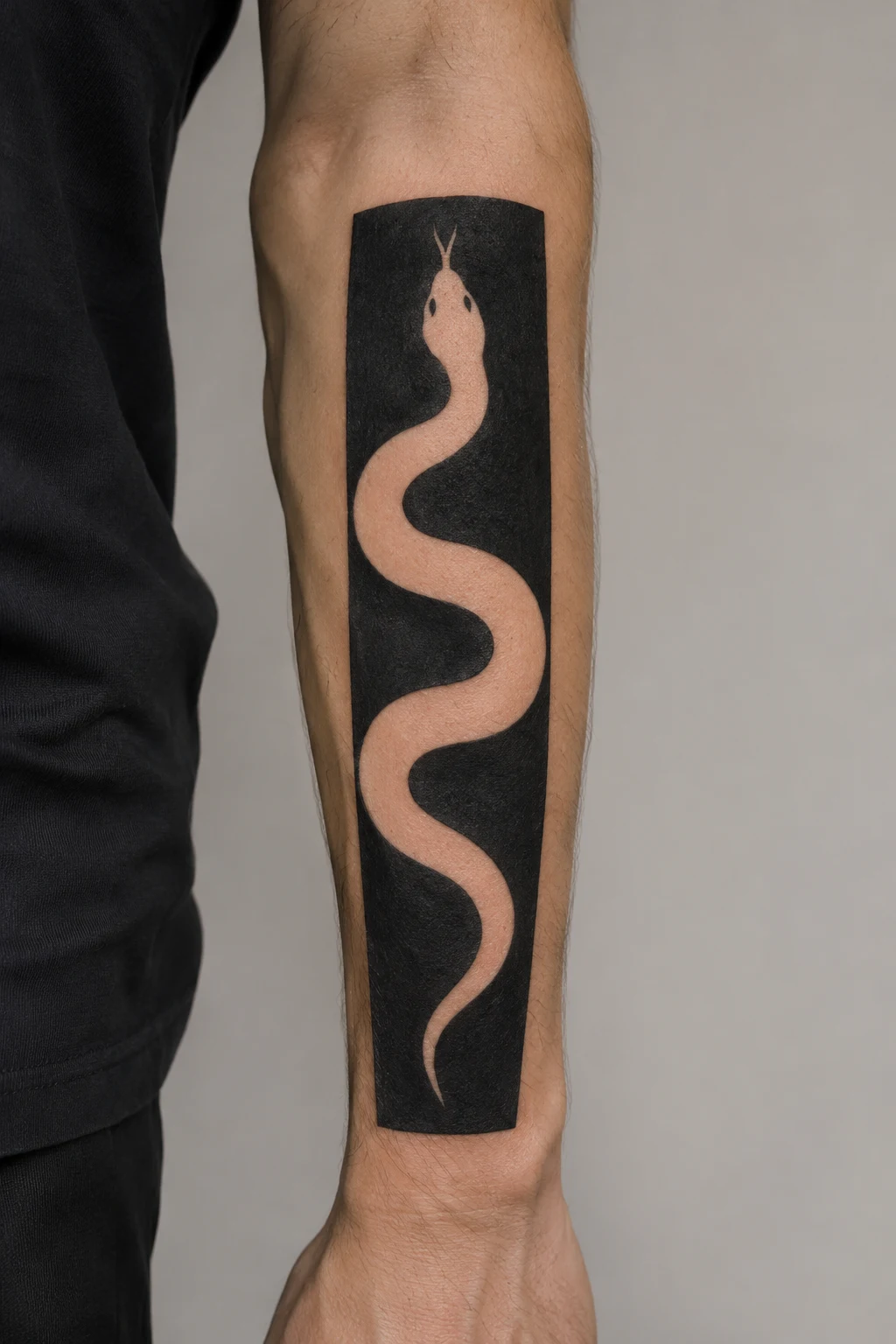
Consider this if substantial black coverage appeals to you. Panel width is a defining choice: discuss how much of the forearm it should occupy before refining the snake inside.
9. Ornamental Snake With Dotwork
Symmetrical flourishes and dotted shading frame a central snake.
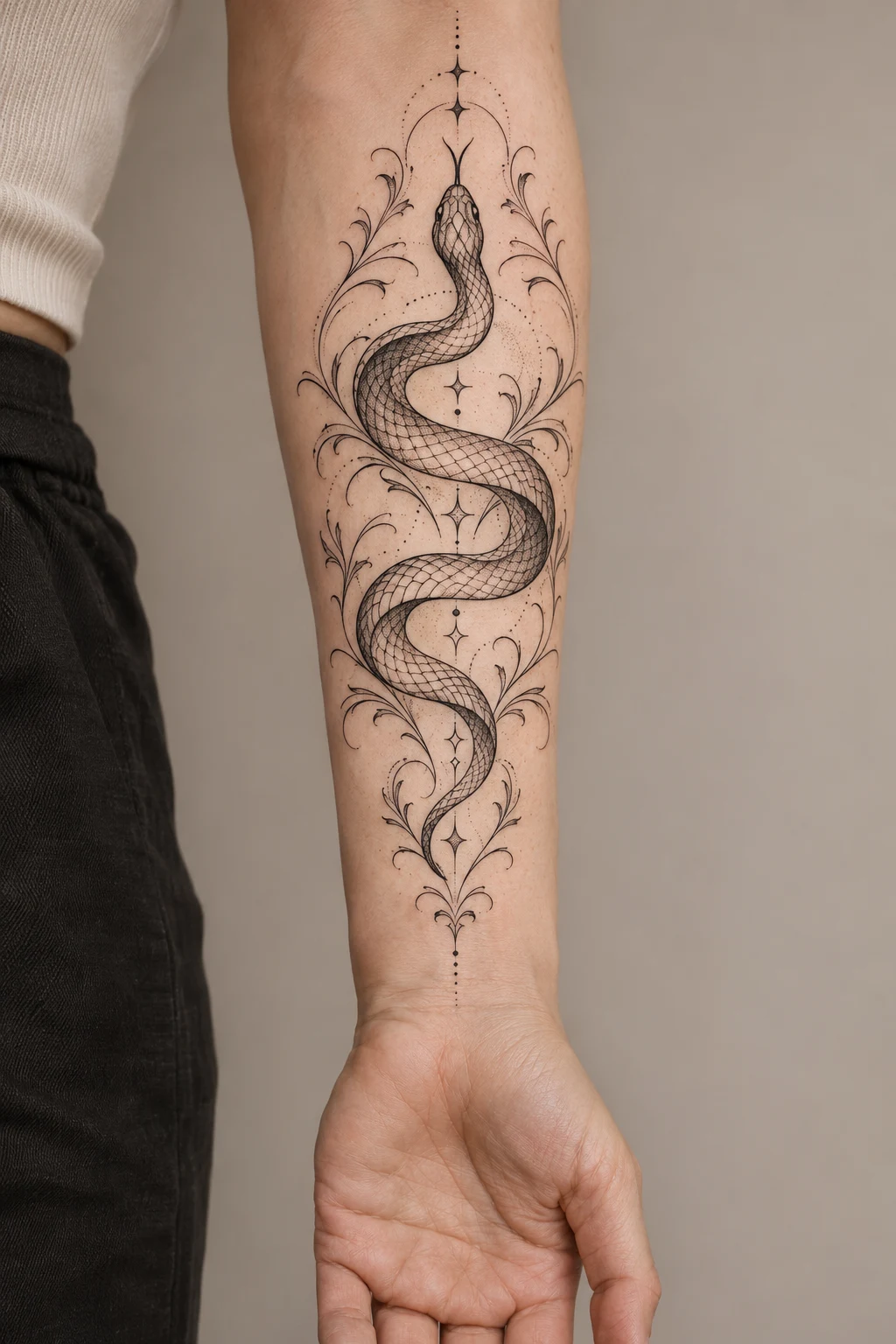
Choose this for a decorative arrangement with a clear center. Decide whether the snake or its frame should dominate, leaving enough separation to keep both recognizable.
10. Banded Snake Forearm Wrap
Alternating dark and unfilled bands follow a snake around the arm.

A wrap suits someone who wants the design to continue across several surfaces. Review the stencil around the whole forearm, including where the head rests when your arm hangs naturally.
Detailed Snakes and Distinctive Poses
These concepts emphasize anatomy, surface detail, and the snake’s posture.
11. Black and Grey Realistic Snake
Shaded overlapping curves give a lengthwise snake a sense of depth.
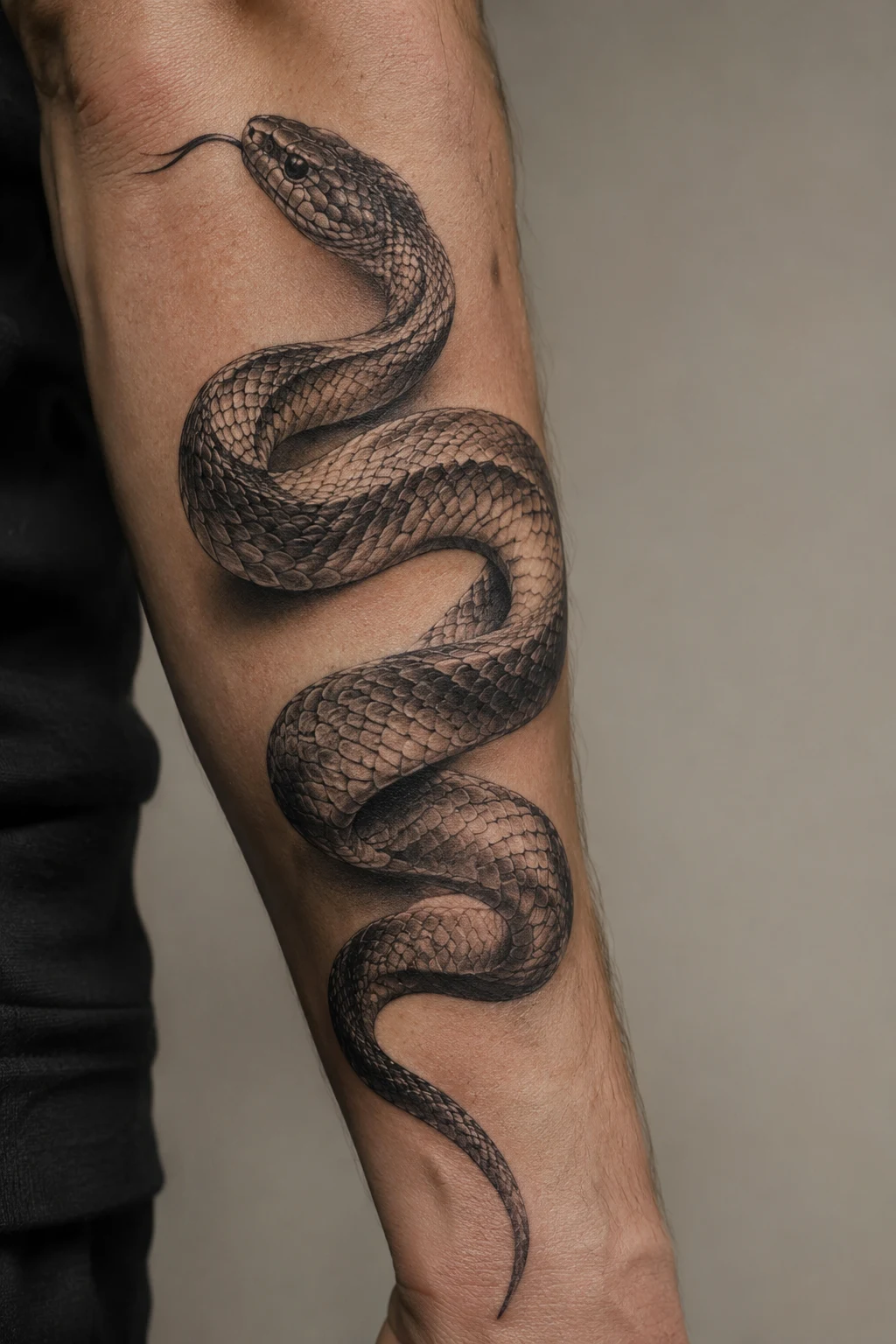
For an animal portrait approach, focus on how shading and scale detail work together. Ask your artist where individual scales add the most value and where simpler shading would keep the composition less crowded.
12. Raised Cobra With an Open Hood
A broad hood near the elbow anchors a body descending toward the wrist.
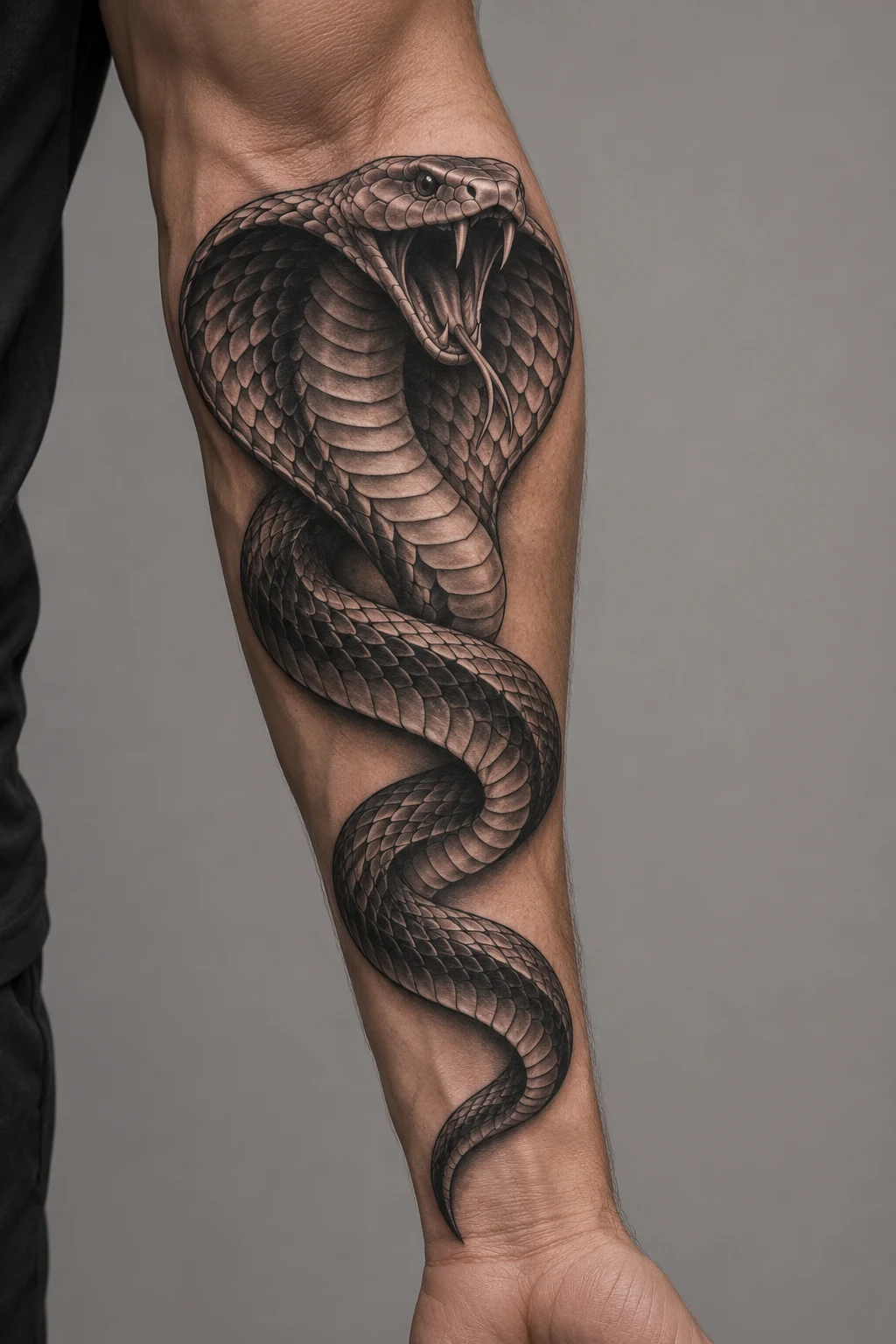
The hood creates a wider upper focal point than a slender winding snake. Check its proportions against the chosen forearm surface before settling on its width.
13. Coiled Rattlesnake With a Visible Rattle
Stacked coils, diamond markings, and a separate rattle define the silhouette.
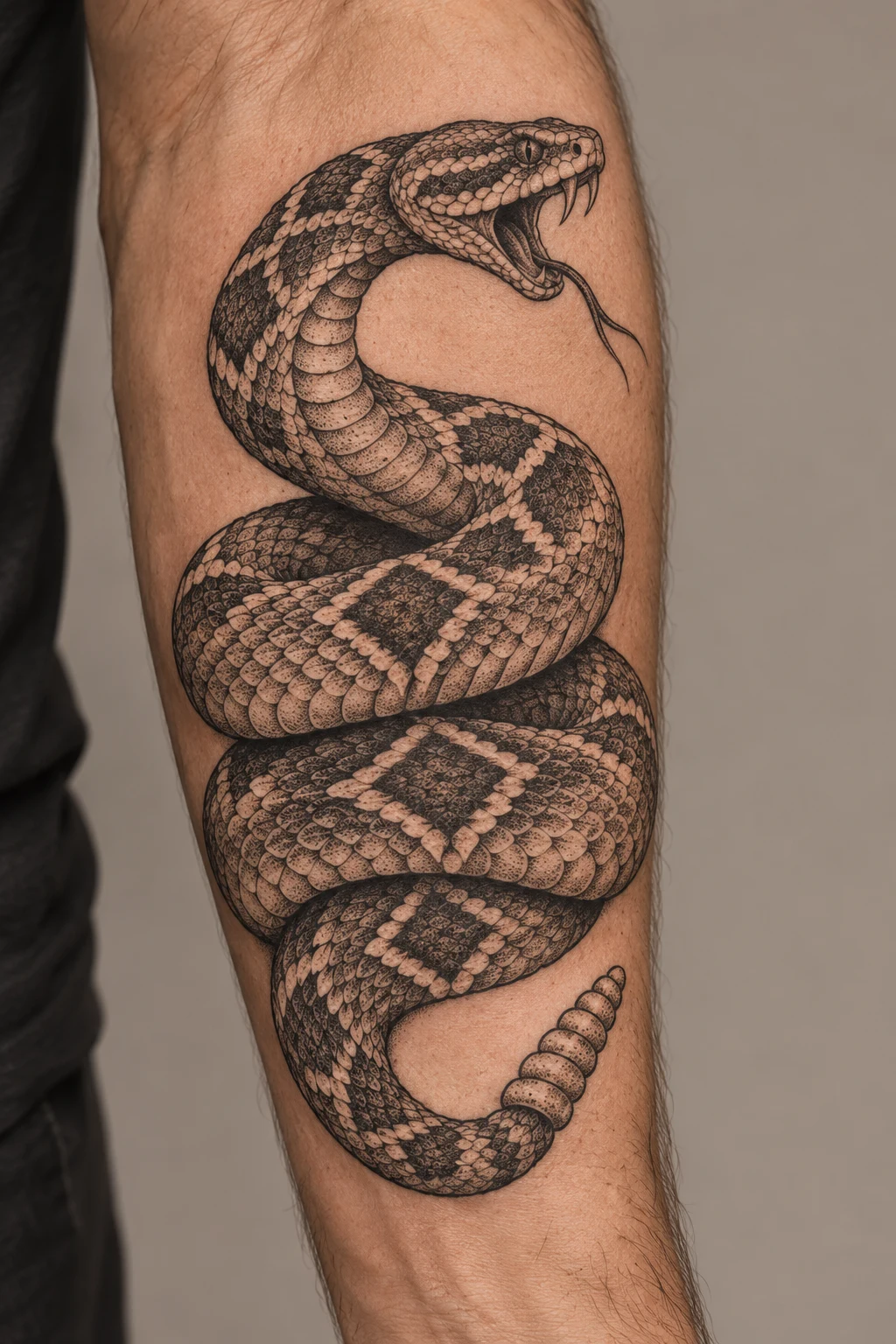
Stacked coils make the pose more compact than a stretched body. Give the rattle its own space and simplify the markings if they crowd the available area.
14. Green Snake on a Slender Branch
A diagonal branch supports a loosely coiled green snake.

Color and a climbing pose distinguish this concept. A simple branch keeps attention on the snake, while its diagonal line gives the composition a different rhythm from a vertical design.
15. Close-Up Snake Head
A closed-mouth profile concentrates detail in the head and curved neck.
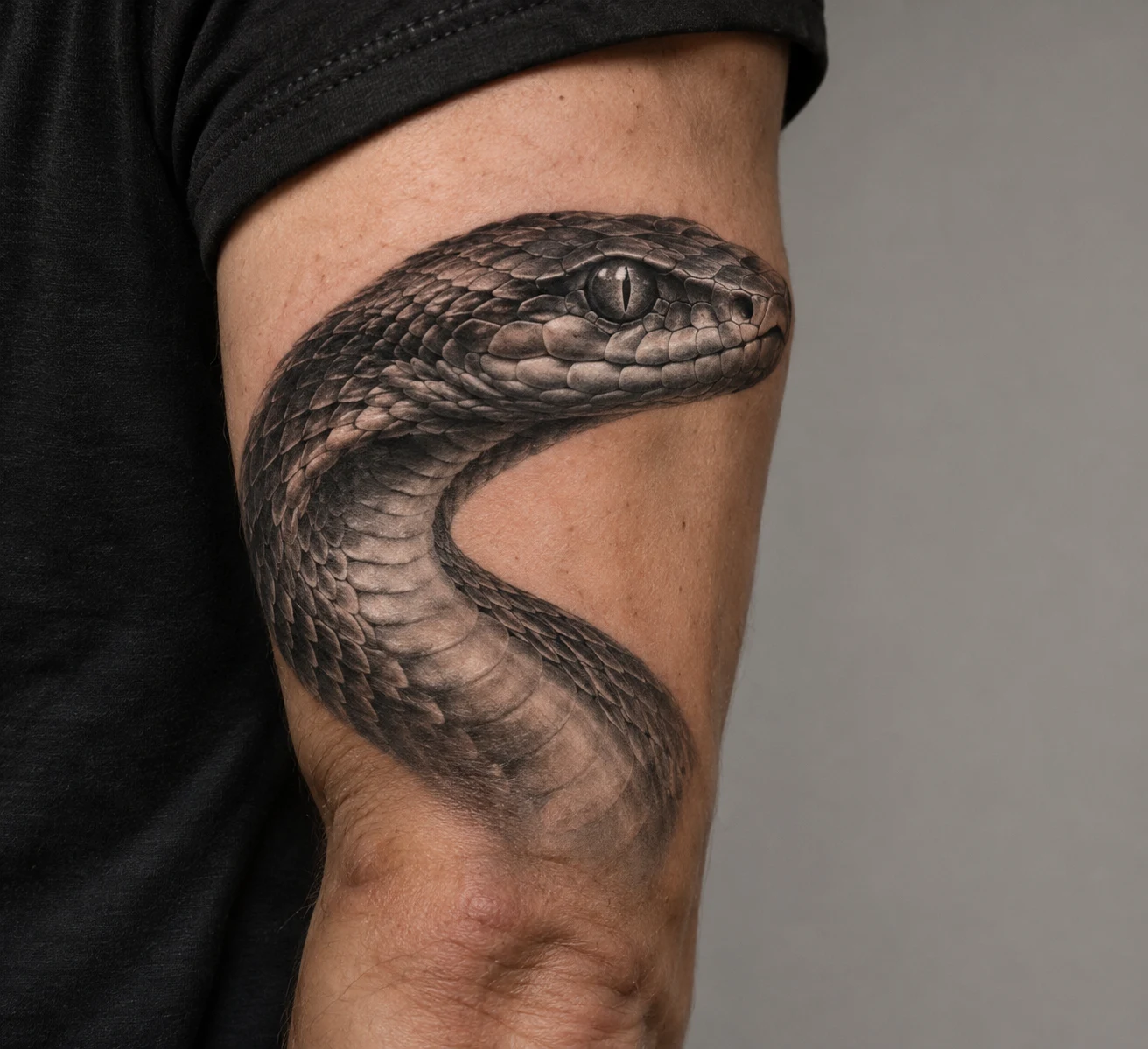
A close-up gives facial structure more attention than a full-body silhouette. Discuss which features should stand out so scale patterns support the portrait without overwhelming it.
Snakes With Flowers, Objects, and Other Motifs
A second subject changes the layout and gives you another way to personalize the design.
16. Snake Woven Through a Rose Stem
One rose creates a rounded focal point above a winding snake.
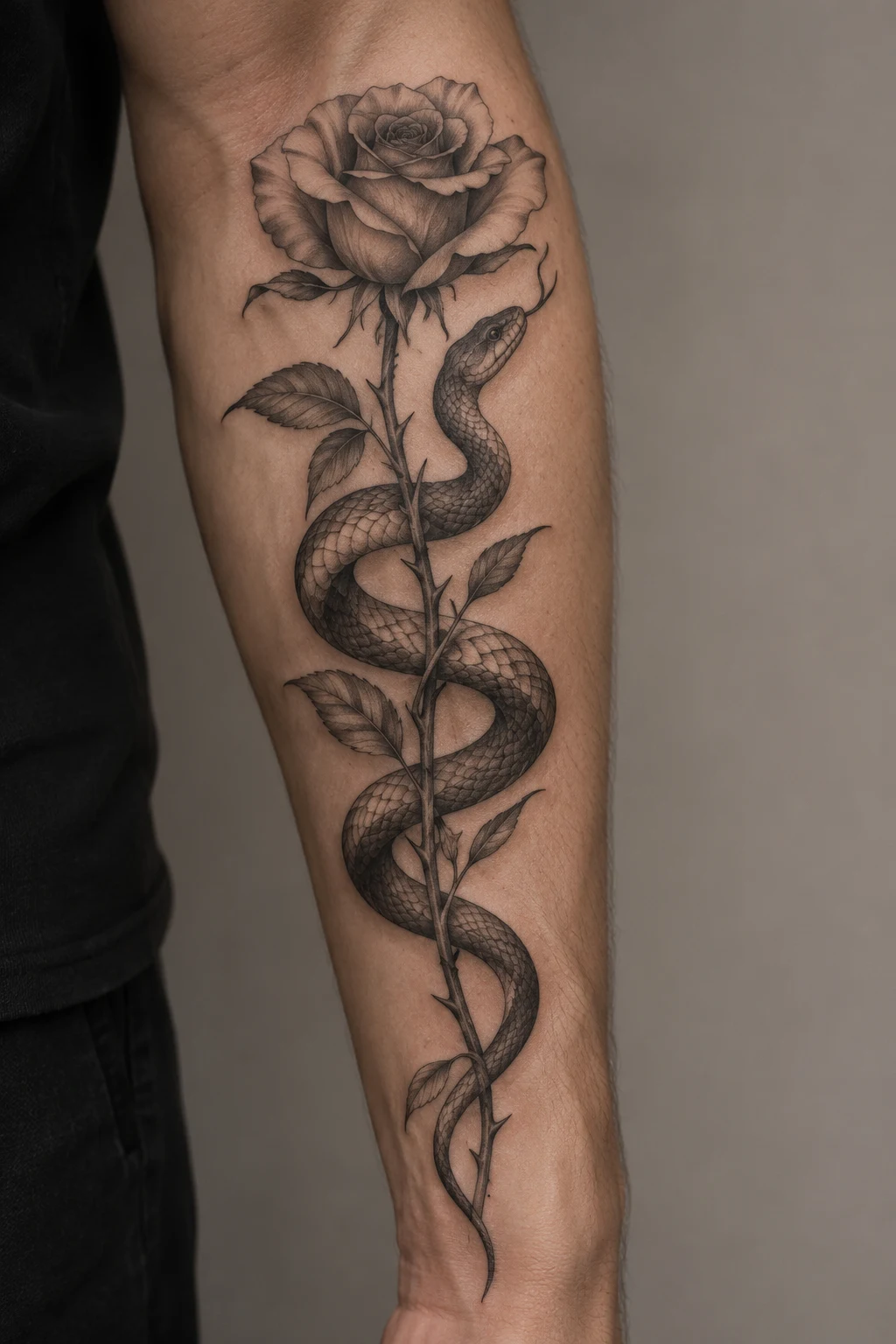
Let the flower occupy the upper portion while the stem and snake carry movement downward. Choose which subject leads before deciding how tightly they should intertwine.
17. Snake Around a Dagger
A straight dagger provides an axis for the snake’s curves.

The dagger gives the composition a defined top and bottom. Check its direction with your arm relaxed, and leave its blade distinguishable between the coils.
18. Snake Through a Skull
A snake passes through an eye socket and curls beneath the jaw.
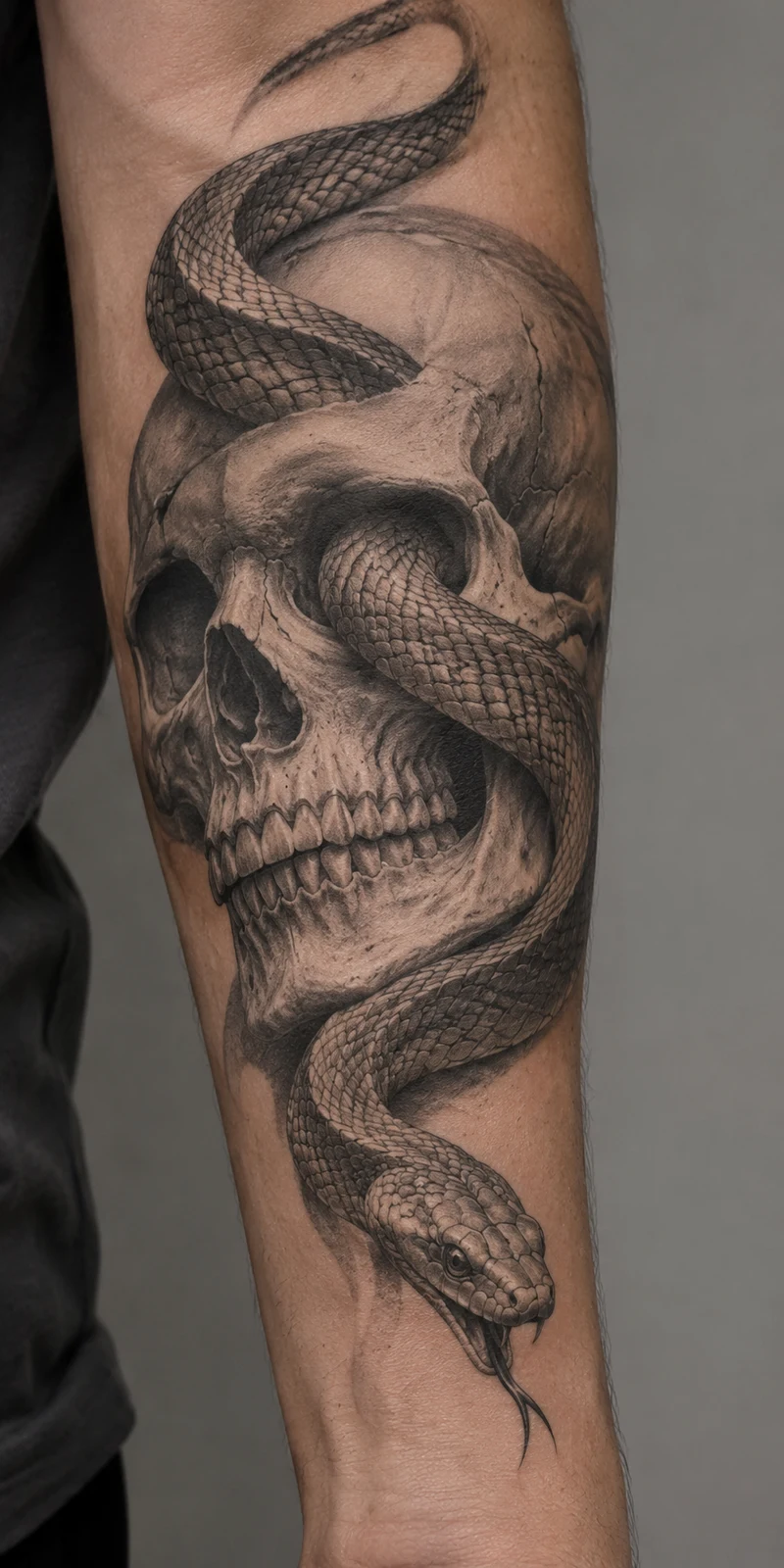
Choose this if you want a layered composition with substantial detail. Allow room for the skull openings and snake body to remain separate; simplifying either subject may help at smaller sizes.
19. Snake and Butterfly
An open-winged butterfly sits above a loose snake curve.
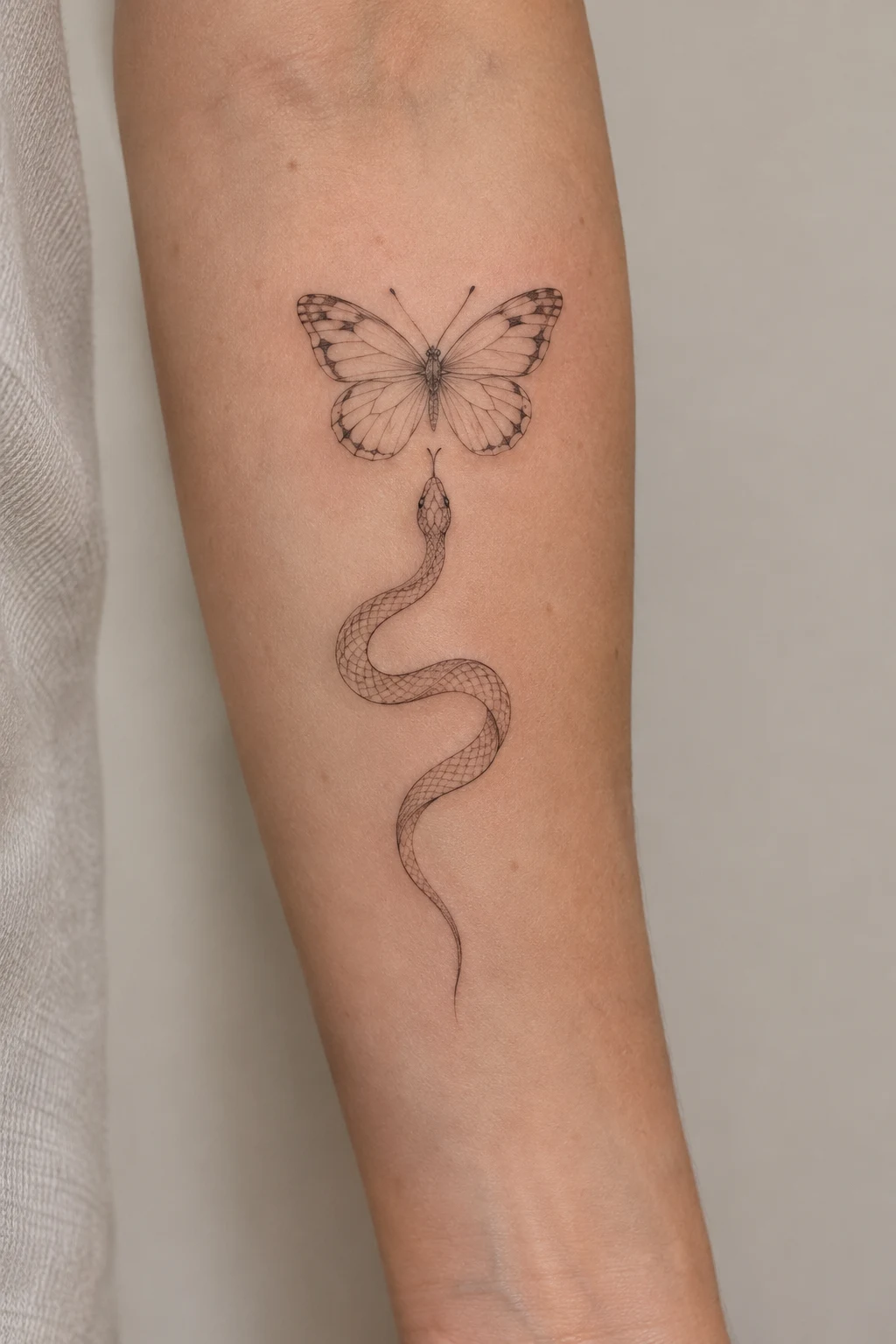
The two silhouettes offer contrast without dense interweaving. Keep a gap between them for an airy layout, or bring them closer if you want the pairing to feel more connected.
20. Ouroboros With a Small Fern
A snake biting its tail forms a ring crossed by a small fern.
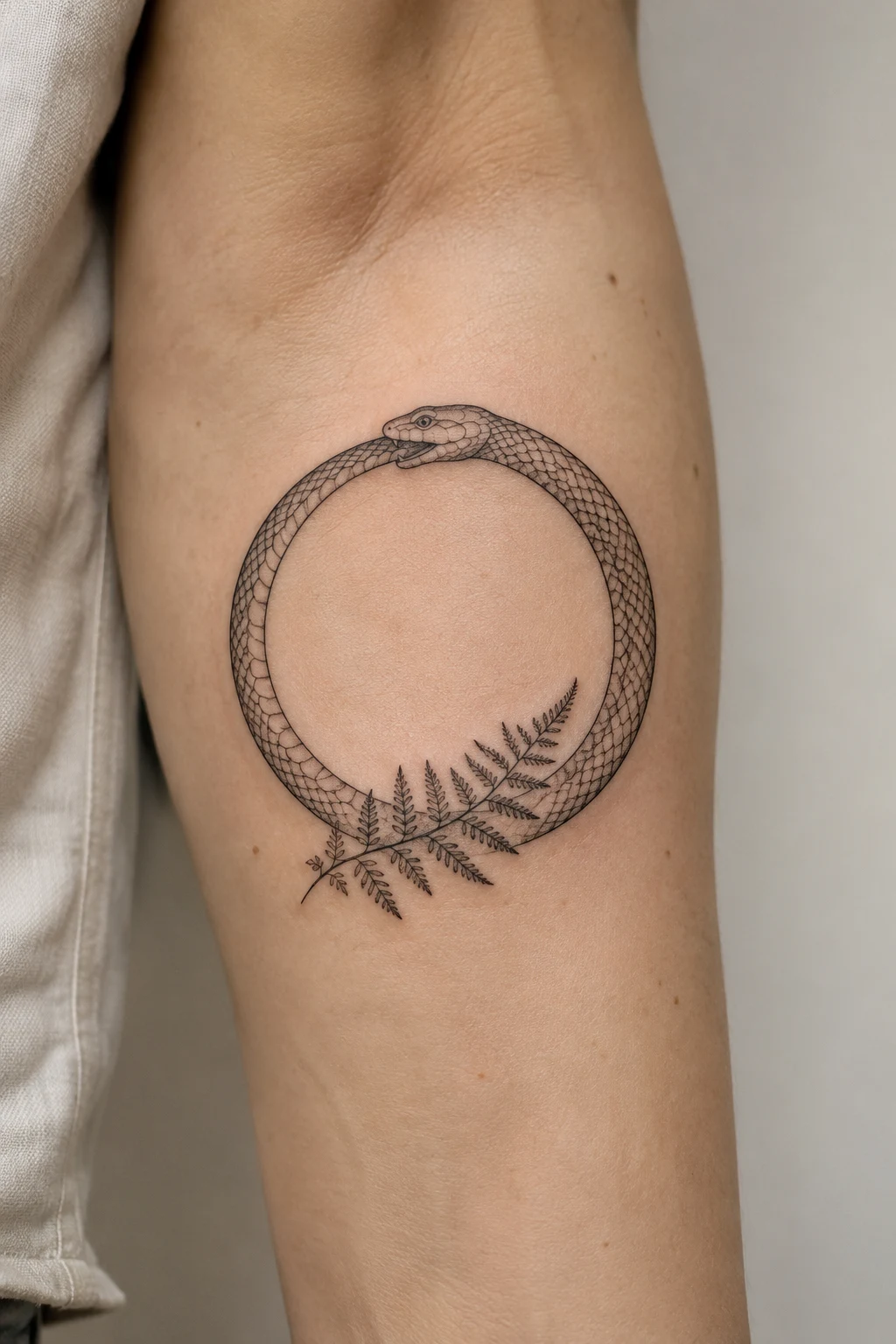
The ring forms a compact emblem rather than a lengthwise design. Keep the fern restrained so it accents the circle without obscuring the meeting point of head and tail.
Choosing Your Direction
Shortlist two or three concepts by coverage, detail, and placement. Bring those references to an artist to discuss scale and orientation, then view the stencil as your arm turns. If you’re still comparing placement options, explore the broader forearm tattoos guide.

